For businesses on the Turkish Riviera, energy is one of the largest and least predictable operating costs, and Antalya solar energy is the most direct way to control it. Commercial solar in Antalya turns roofs, car parks and spare land into a source of low-cost, emission-free power that protects margins against tariff increases and gives sustainability reports hard numbers.
We deliver turnkey systems for hotels, factories, cold stores, offices, schools and retail sites, from feasibility to long-term monitoring. Our industrial references include rooftop plants up to 4.5 MW, and the same engineering care goes into a 50 kW boutique hotel system.
Why commercial solar energy in Antalya pays
- Daytime demand: most businesses use the bulk of their electricity in working hours, when solar is producing.
- Summer peak: cooling loads in hotels, offices and cold stores coincide with Antalya's strongest sun.
- Higher unit prices: commercial tariffs make every self-consumed kilowatt-hour more valuable.
- Large roofs: industrial and hotel buildings offer space for substantial systems at a lower cost per kilowatt-peak.
- Typical payback: businesses with strong daytime demand typically see payback in roughly four to six years.
There is also a strategic argument. Electricity prices in Turkey have risen sharply in recent years, and energy has become one of the hardest costs to forecast. An Antalya solar energy plant fixes the cost of a large share of your supply on the day it is commissioned, for 25 years and more. That budget certainty is valuable for hotels setting seasonal room rates, for manufacturers quoting long-term contracts and for any business whose margins depend on controlling overheads.
Solar for Antalya's hotels and resorts
Few businesses match Antalya solar energy as naturally as a Mediterranean hotel. Cooling, laundry, kitchens, pool pumps and hot water all peak during the long, bright summer season, exactly when production is highest. Roofs, service buildings and staff car parks offer space for arrays, and solar car-park canopies add welcome shade for guests. Beyond the energy saving, visible renewable generation supports the sustainability commitments that tour operators and international guests increasingly expect, and it gives hotels credible data for environmental reporting and eco-label applications. We plan installation work outside peak season so guests are never disturbed.
Factories, cold stores and warehouses
Manufacturing and logistics buildings combine large, unshaded roofs with steady daytime loads: motors, compressors, lighting and refrigeration. Cold stores serving Antalya's fruit and vegetable trade are especially well suited, since their heaviest cooling demand falls in the sunniest months. Before design we check the roof structure, the condition and remaining life of the roofing, fire-safety access routes and the capacity of the existing transformer and switchgear, so the system integrates safely with production.
Safety and insurability are designed in from the start. We keep fire-service access corridors clear on large roofs, specify DC isolation and protection appropriate to the building, and document the installation so that your insurer and fire-safety consultant can review it easily. Where a roof membrane is close to the end of its life, we recommend renewing it before installation, because removing a commercial array later for roof repairs is far more expensive than planning ahead.
Typical commercial system profiles
| Business type | Typical system range | Load pattern | Design focus |
|---|---|---|---|
| Boutique hotel or villa complex | 30–150 kWp | Strong summer daytime cooling | Roof and car-park canopies |
| Large resort | 300 kWp–1 MWp+ | Year-round base load, summer peak | Multiple roofs, phased build |
| Factory or workshop | 100 kWp–several MWp | Weekday production hours | Structural checks, grid capacity |
| Cold store or packhouse | 100–500 kWp | Harvest-season cooling | Self-consumption, possible storage |
| Office, school or retail | 20–200 kWp | Working-hours lighting and HVAC | Visible sustainability |
From feasibility to commissioning: our turnkey process
- Feasibility: consumption analysis from meter data, roof and structural survey, shading model and yield simulation.
- Business case: investment, expected savings and payback under clearly stated tariff and netting assumptions.
- Engineering: single-line diagram, structural calculations, cable routing and protection design.
- Applications: preparation and submission of the grid application to the regional distribution company (EDAŞ).
- Construction: phased installation planned around your operations, with a short, agreed shutdown for the final connection.
- Acceptance and handover: inspection and acceptance, metering, monitoring set-up and staff briefing.
Regulation and grid connection for businesses
Commercial systems for self-consumption generally fall under the Regulation on Unlicensed Electricity Generation, supervised by EPDK. Rules on eligibility, capacity and netting, including whether settlement is monthly or hourly and how surplus is treated, have been revised several times and depend on subscriber group and connection type. Rather than relying on outdated rules of thumb, we confirm the provisions in force for your site and state every assumption in the business case.
For larger systems, grid capacity is often the deciding factor. The available capacity at your connection point, the rating of your transformer and the distribution company's assessment of the local network all influence the maximum system size and the timeline. We review these early, so that the design you approve is one the grid can actually accept.
Monitoring, reporting and ESG
Every commercial system comes with a monitoring platform that tracks production at inverter and string level, compares it with consumption and sends automatic alerts when performance drops. For sustainability teams, the same data quantifies the reduction in purchased electricity, and therefore in Scope 2 emissions, with verifiable figures rather than estimates. Monthly and annual reports can feed directly into ESG disclosures, supplier questionnaires and customer communications. Typical report contents include:
- Energy generated, self-consumed and exported per month.
- Performance compared with the original yield simulation.
- Avoided CO₂ emissions, calculated transparently.
- Fault events, response times and maintenance carried out.
Industrial rooftops we have delivered
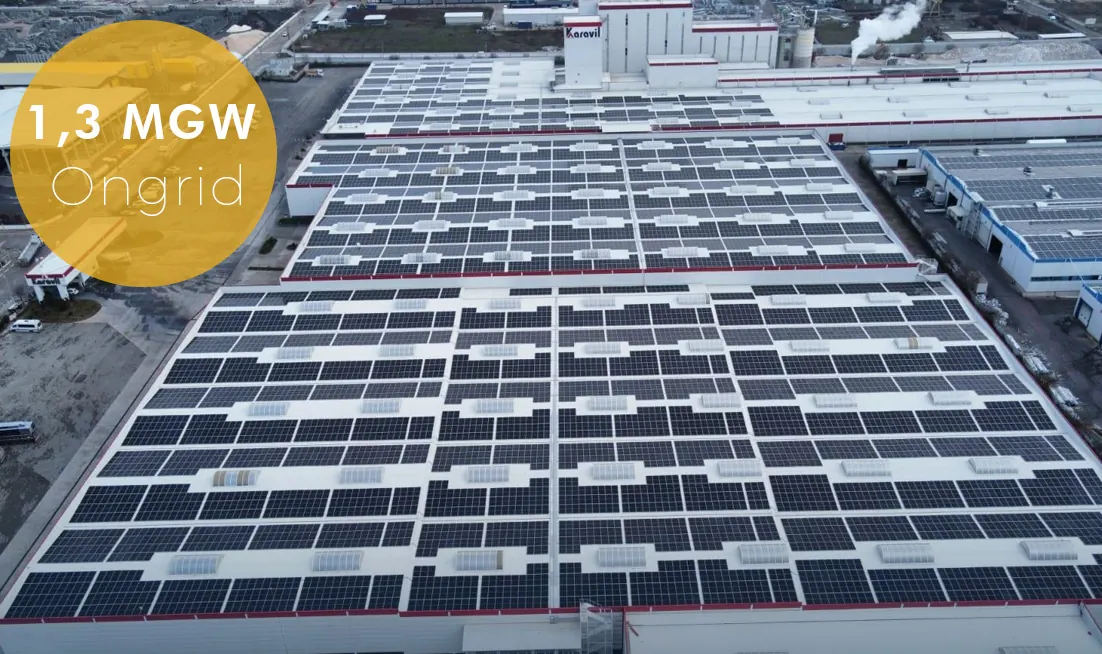
Our commercial and industrial references include on-grid rooftop systems of 450 kW, 860 kW, 970 kW, 1.3 MW and 4.5 MW, alongside 680 kW and 2.4 MW ground-mount plants. Each project began with a structural assessment, a detailed consumption analysis and a cable routing plan designed to keep production running during installation. These plants now cover a substantial share of their buildings' daytime demand and report generation continuously. Several were built in phases, with each section connected and producing before the next began, so the client started saving before the whole roof was complete.
Adding battery storage to a commercial system
For some businesses, storage adds value beyond self-consumption. A battery can reduce demand peaks, keep critical loads such as servers, cold rooms or reception systems running during outages, and store midday surplus for evening service. Our 40 kW hybrid system in Manavgat shows solar and storage working together at commercial scale. Learn more on our hybrid and battery page, or request a commercial feasibility study.