For most homes and businesses in the city and along the coast, an on-grid solar system is the simplest and most cost-effective way to use Antalya solar energy to cut electricity bills and emissions at the same time. The panels supply your property during the day, any surplus flows into the grid, and the exchange is netted against your consumption under Turkish regulation.
Because there is no battery to buy, every lira goes into generating capacity, which keeps the cost per kilowatt-hour low and the payback short. And because the grid acts as a back-up, the system never needs to be oversized for winter. Below we explain how net metering works in Turkey, how the connection process unfolds and what an on-grid system typically delivers in Antalya's climate.
What an on-grid system is and why most projects start here
A grid-tied installation consists of the solar array, one or more inverters that convert DC to grid-quality AC, protection devices and a bidirectional meter that records both imported and exported energy. When your panels produce more than you use, the surplus is exported; when they produce less, at night or during heavy use, you draw from the grid as usual. You never notice the switch.
This simplicity makes on-grid solar the natural starting point for villas, apartments, offices, hotels and factories. It is also future-proof: with a hybrid-ready inverter, battery storage can be added later.
How net metering works in Turkey
Grid-connected solar for self-consumption falls under the Regulation on Unlicensed Electricity Generation (Lisanssız Elektrik Üretim Yönetmeliği), supervised by the Energy Market Regulatory Authority (EPDK). In broad terms the process works like this:
- Your system is linked to an existing electricity subscription at the same or an associated consumption point.
- Energy produced is consumed in the property first, reducing what you buy at the moment of generation.
- Surplus is exported to the grid and recorded by the bidirectional meter.
- Exports are netted against imports over the settlement period that applies to your subscriber group.
- Surplus that exceeds what can be netted is treated according to the current rules, which may pay it at a regulated rate or limit it.
From application to activation: the connection process
The paperwork is where many projects stall, so we manage it from start to finish. A typical sequence looks like this:
- Survey and pre-design: we confirm roof area, shading, existing connection capacity and subscription details.
- Application: we submit the application and supporting documents to the regional distribution company (EDAŞ).
- Connection opinion and agreement: once the network capacity is approved, the connection agreement is prepared for your signature.
- Project approval and installation: the electrical project is approved and our crew installs the system.
- Acceptance and metering: after inspection and acceptance in line with TEDAŞ procedures, the bidirectional meter is fitted and netting begins.
For homes and small businesses this commonly takes one to two months; larger commercial and industrial systems can take several months, depending on grid capacity and document flow.
Sizing for self-consumption, not just for the roof
The most valuable kilowatt-hour is the one you use directly, because it replaces electricity bought at the full retail price. Where netting is calculated over short periods, such as hourly, exporting at midday and importing in the evening is worth less than consuming solar power as it is produced. We therefore size systems from your real consumption profile and look for ways to shift loads into daylight hours: pool filtration, water heating, laundry, cold rooms and production lines.
Households with high annual consumption deserve special attention. Homes above the consumption threshold set for the residential tariff pay a higher, unsubsidised rate, which often makes solar significantly more attractive for large villas with pools and several air conditioners.
On-grid solar energy in Antalya: what to expect
Antalya solar energy benefits from roughly 3,000 hours of sunshine a year: a well-oriented array in the region typically produces around 1,500 to 1,600 kWh per kilowatt-peak annually. Orientation, tilt, shading and temperature all influence the exact figure, which we calculate in your yield simulation.
| System size | Indicative annual generation | Typical user |
|---|---|---|
| 3–5 kWp | 4,500–8,000 kWh | Apartment or small villa |
| 8–12 kWp | 12,000–19,000 kWh | Large villa with pool |
| 30–100 kWp | 45,000–160,000 kWh | Boutique hotel, office, workshop |
| 400 kWp–1 MWp | 0.6–1.6 GWh | Factory, cold store, large hotel |
From a 3.3 kW tiled roof to 4.5 MW: our on-grid references
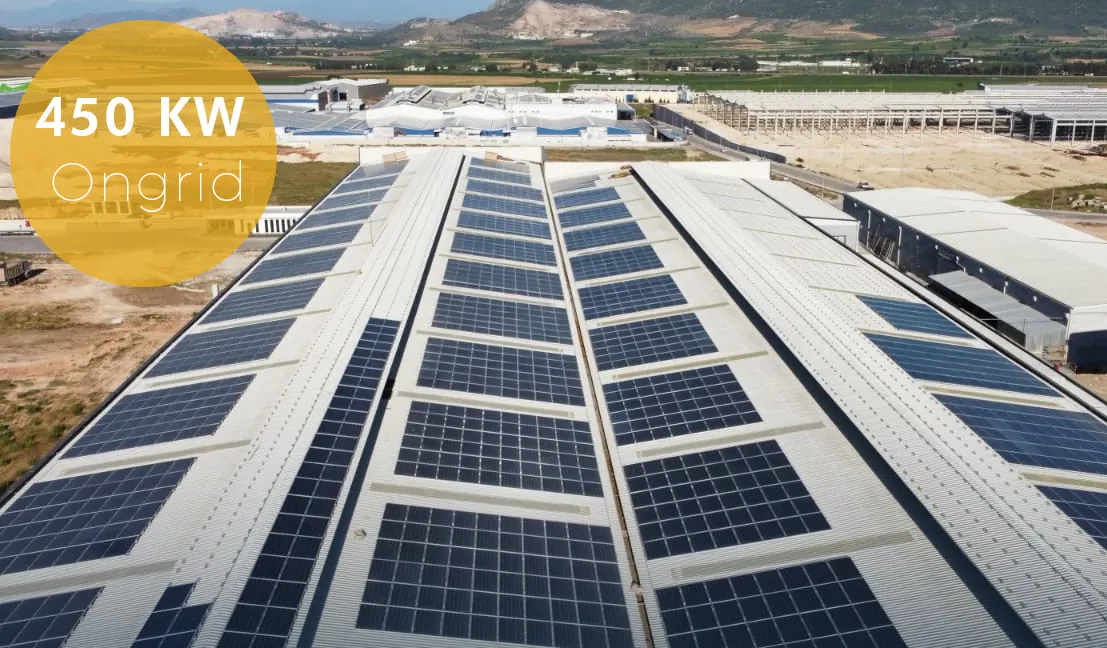
Our on-grid portfolio covers the full range. At the residential end, a 3.3 kW system on a tiled roof shows how even a modest array meaningfully reduces a household bill. In industry we have delivered rooftop plants of 450 kW, 860 kW, 970 kW, 1.3 MW and 4.5 MW, each engineered around the building's structure and its daytime production load. On open land, our 680 kW and 2.4 MW ground-mount plants demonstrate how optimal tilt and row spacing maximise yield. See more on our projects page.
Inverters, monitoring and future-proofing
We select inverters according to roof geometry and shading: string inverters for clean, uniform roofs, and module-level optimisation where chimneys, trees or neighbouring buildings cast partial shade. All grid-tied inverters include anti-islanding protection, so the system shuts down safely during a power cut. Every installation comes with a monitoring platform that shows production, consumption and avoided CO₂, and we can receive automatic alerts for commercial systems.
Solar energy in Antalya also delivers a measurable climate benefit. Because Turkey's grid still draws heavily on gas and coal, each kilowatt-hour your system exports or consumes directly displaces fossil generation. Your monitoring app tracks this avoided CO₂ alongside production, which gives households a clear picture of their progress towards a carbon-neutral home and gives businesses verifiable data for Scope 2 and ESG reporting.
Is an on-grid system right for you?
- Choose on-grid if you have a reliable grid connection and want the lowest cost per kilowatt-hour and the fastest payback.
- Consider hybrid if you use most of your electricity in the evening, experience frequent outages or want backup for essential loads.
- Go off-grid only where no practical grid connection exists; see our off-grid solar page.
Send us a recent bill and we will model your on-grid system, explain the netting rules that apply to you and prepare a transparent proposal. Book your free survey.