From the citrus groves of Kumluca and Finike to the vegetable fields of Aksu, Serik and Manavgat, Antalya's agriculture runs on water, and lifting that water costs energy. Solar irrigation in Antalya replaces diesel generators and expensive grid connections with pumps powered directly by solar energy in Antalya's fields, at the very moment crops need water most.
The logic is compelling: irrigation demand peaks in the long, dry summer, exactly when solar output is highest. A solar pump has no fuel to buy, no engine to service and no tank to refill, and it produces no emissions or noise in the field. For growers aiming to cut costs and present a greener product to buyers and exporters, it is one of the most practical sustainability investments available.
Why growers are switching to Antalya solar energy for pumping
- No fuel logistics: no more diesel runs to remote fields, no fuel theft and no price shocks in the middle of the season.
- Grid independence: wells far from distribution lines can be pumped without costly line extensions or transformers.
- Lower running costs: after installation, the energy itself is free and maintenance is minimal.
- Climate benefit: every litre of diesel not burned avoids CO₂ and local air pollution.
- Automation: modern pump drives start and stop with the sun and can respond to tank-level or soil-moisture sensors.
How a solar pumping system works
A solar irrigation system is simpler than most people expect. Panels mounted on a ground frame near the well feed a solar pump drive, a variable-frequency controller with maximum power point tracking. The drive adjusts pump speed continuously to the available sunlight: slow in the early morning, full speed at midday. Submersible pumps lift water from boreholes, while surface pumps move water from reservoirs or canals into drip or sprinkler networks. Protection against dry running, overload and lightning is built into the design.
Sizing a solar pump: water first, watts second
A reliable design starts with hydraulic data, not with a panel count. During the survey we collect:
- Well depth, static and dynamic water level and borehole diameter.
- Required daily water volume in the peak month, based on crop, area and irrigation method.
- Total head, including lift height, pipe length and drip or sprinkler pressure.
- Existing pump and motor data, if you want to keep your current equipment.
- Irrigation calendar: which months and which hours the system must deliver.
From these figures we select the pump and drive, then size the array somewhat above the pump's rated power so it starts early, runs through hazy spells and delivers the required volume across the season.
| Application | Typical pump | Design focus |
|---|---|---|
| Citrus and pomegranate orchards | Submersible borehole pump | Summer peak volume, drip pressure |
| Open-field vegetables | Submersible or surface pump | Daily volume over a long season |
| Greenhouse clusters | Surface pump with storage tank | Stable pressure, fertigation timing |
| Livestock and household water | Small submersible pump | Year-round reliability, tank buffer |
Drip irrigation and fertigation: more crop per kilowatt-hour
The most efficient solar pump is the one that moves less water to grow the same crop. Pairing solar pumping with drip irrigation delivers water directly to the root zone, cuts evaporation losses in Antalya's summer heat and lowers the volume the pump has to lift each day. That in turn reduces the size, and the cost, of the solar array. Drip networks also make fertigation straightforward: nutrients dosed into the irrigation water reach plants evenly, and the pump drive's steady daytime operation suits automatic dosing units well.
When we design a solar irrigation system, we therefore look at the whole water path, from well to emitter. Sometimes replacing worn pipes, adding a filter station or re-zoning a field saves more energy than adding panels, and we will recommend that when it is the smarter investment.
Our 5.5 kW field irrigation reference
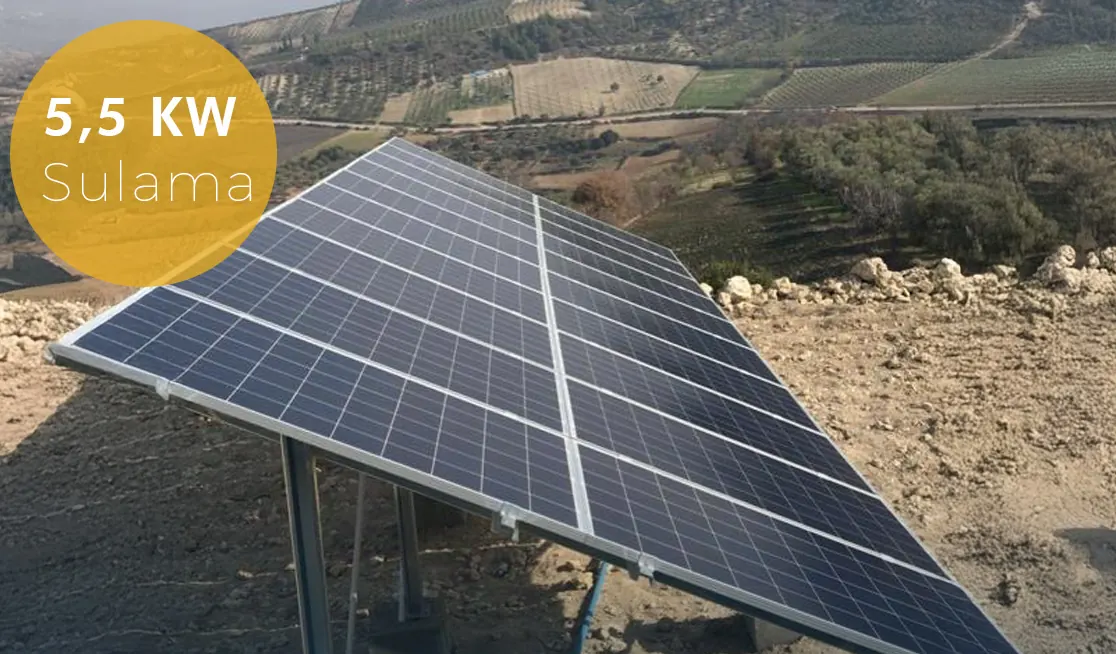
One of our reference projects is a 5.5 kW ground-mounted solar irrigation system installed directly in an open field. The array sits on a robust ground frame beside the water source and drives the pump without any grid connection or fuel supply. It is a good example of how a compact, well-planned system can take an entire field off diesel and onto Antalya solar energy. Because the field is remote, the installation was designed for low maintenance: corrosion-resistant mounting, protected cabling and a drive that restarts automatically each morning.
Grid-connected options for agricultural subscribers
Where an agricultural irrigation subscription already exists, a grid-connected system under the Regulation on Unlicensed Electricity Generation can be an alternative to a stand-alone pump. Energy produced when the pump is idle, in spring or autumn for example, can be netted against consumption according to the rules that apply to your subscriber group. Because these rules are revised from time to time, we check the current EPDK provisions and the distribution company's requirements before recommending this route. For wider farm energy needs, see our agricultural solar page.
Costs and payback compared with diesel
The investment depends on pump power, well depth, water volume and mounting conditions, so we price every system individually after the survey. What does not change is the structure of the comparison: a diesel pump costs little to buy but a great deal to run, while a solar pump costs more up front and very little afterwards. For fields irrigated through the whole summer, the fuel and maintenance saved typically recovers the investment within a few seasons, and panels warranted for 25 years keep pumping long after.
Our proposal sets out both sides of that comparison transparently: the expected annual pumping volume, the diesel or grid energy it replaces and the resulting saving, based on your own fuel consumption records wherever they are available. If a grid-connected or hybrid solution is better for your farm, we will show that too.
Maintenance, monitoring and protection in the field
- Clean panels after dusty periods and harvests, especially near unpaved roads.
- Check pipe filters and drip lines regularly so the pump is not working against blockages.
- Use anti-theft fasteners and, where needed, fencing around the array.
- Add remote monitoring to see pump status and output without driving to the field.
Solar irrigation is one of the clearest wins for solar energy in Antalya's agriculture: lower costs, cleaner air and water delivered exactly when the sun is strongest. Book a free field survey and we will design a system around your well, your crops and your season.