Every roof in the province receives far more sunshine than the building beneath it can use. Rooftop solar in Antalya captures that energy where it falls, turning tiled villa roofs, flat apartment terraces and vast factory sheds into quiet, emission-free power stations and putting solar energy in Antalya to work without using a single square metre of new land.
We design rooftop systems for homes, hotels, offices and industry across the province, from a 3.3 kW tiled-roof home to a 4.5 MW industrial roof. This page explains how we assess a roof, which mounting solutions suit which surfaces, what a rooftop array typically produces and how we keep it performing for decades.
Why rooftops lead solar energy in Antalya
With roughly 3,000 hours of sunshine a year, Antalya solar energy yields are among the best in Europe: a well-oriented array typically produces around 1,500 to 1,600 kWh per kilowatt-peak annually, far more than in central or northern Europe. Just as importantly, production peaks in the long summer months, when air conditioning, pool pumps, cold rooms and hotel chillers drive consumption to its highest point. Generation and demand line up naturally, which means a large share of rooftop energy is used directly, the most valuable way to use it.
Roof types we work with
No two roofs are the same, so the mounting system is always chosen for the surface, the structure and the local wind exposure:
- Tiled roofs: stainless roof hooks are fixed to the rafters beneath the tiles, so the waterproof layer stays intact and tiles are refitted around each hook.
- Flat concrete roofs: tilted aluminium frames, ballasted or anchored, set the panels at an efficient angle and leave space for maintenance walkways.
- Trapezoidal and standing-seam metal: rails or clamps attach directly to the profile, keeping weight low on industrial buildings.
- Sandwich-panel factory roofs: lightweight systems are specified after a structural check of purlins and load capacity.
- Pergolas and carports: purpose-built structures create shade and generate power where the main roof is unsuitable.
Designing the array: orientation, shading and layout
South-facing roofs give the highest yield per panel, but east and west orientations also perform well in Antalya and spread production across the morning and late afternoon, which often matches household routines better. The bigger enemy is shade. Chimneys, solar water heaters, parapet walls, satellite dishes and neighbouring buildings can all cast shadows that reduce the output of an entire string. During the survey we map these obstacles and simulate their effect through the seasons, then design the string layout accordingly. Where shading cannot be avoided, module-level optimisation keeps one shaded panel from pulling down the rest.
The coastal climate adds its own engineering requirements. Fixings are calculated for local wind loads, including the winter storms that sweep the coast; within a few hundred metres of the sea we use corrosion-resistant materials throughout; and an air gap beneath the modules lets heat escape in summer, protecting both output and component life.
Indicative rooftop system sizes
As a rough guide, each kilowatt-peak needs about five to six square metres of unshaded roof with modern panels. The table below shows typical configurations; your exact design follows the survey.
| System size | Approx. roof area | Indicative annual generation | Typical building |
|---|---|---|---|
| 3–5 kWp | 15–30 m² | 4,500–8,000 kWh | Apartment or compact home |
| 8–15 kWp | 45–90 m² | 12,000–24,000 kWh | Villa, often with pool |
| 30–150 kWp | 170–900 m² | 45,000–240,000 kWh | Hotel, office, workshop |
| 500 kWp and above | 3,000 m² and above | 750,000 kWh and above | Factory or logistics roof |
What about solar panel cost in Antalya? The price of a rooftop system depends on its size, the roof type and mounting, cable distances, inverter technology and any battery storage. Larger systems cost less per kilowatt-peak, and simple, unshaded roofs cost less to equip than complex ones. Because component prices and exchange rates move frequently, we do not publish price lists; you receive an itemised written quote after the free survey, together with a realistic payback calculation based on your own bills.
Components chosen to last 25 years
A rooftop system is a long-term asset, so we specify components from financially strong manufacturers. Tier-1 monocrystalline panels come with a 25-year linear performance warranty; inverters typically carry five to ten years of manufacturer warranty depending on the model; and our own installation workmanship is guaranteed for five years. Mounting systems use corrosion-resistant aluminium and stainless fasteners, an important detail near the sea, and all cabling, connectors and protection devices are rated for outdoor use in Mediterranean heat. If you may want storage later, we specify a hybrid-ready inverter so a battery can be added without starting again.
From survey to switch-on
- Free survey: roof condition, structure, shading, electrical panel and connection capacity are checked on site.
- Design and proposal: you receive a panel layout, yield simulation, equipment list and itemised price.
- Application: for grid-connected systems we prepare and submit the documents to the regional distribution company (EDAŞ).
- Installation: most home systems are installed in one to three working days; larger roofs are planned in phases.
- Acceptance and activation: after inspection and acceptance the bidirectional meter is fitted and your monitoring app goes live.
How exported energy is netted depends on the current EPDK rules for your subscriber group; our on-grid solar page explains the principles.
Rooftop references: from 3.3 kW to 4.5 MW
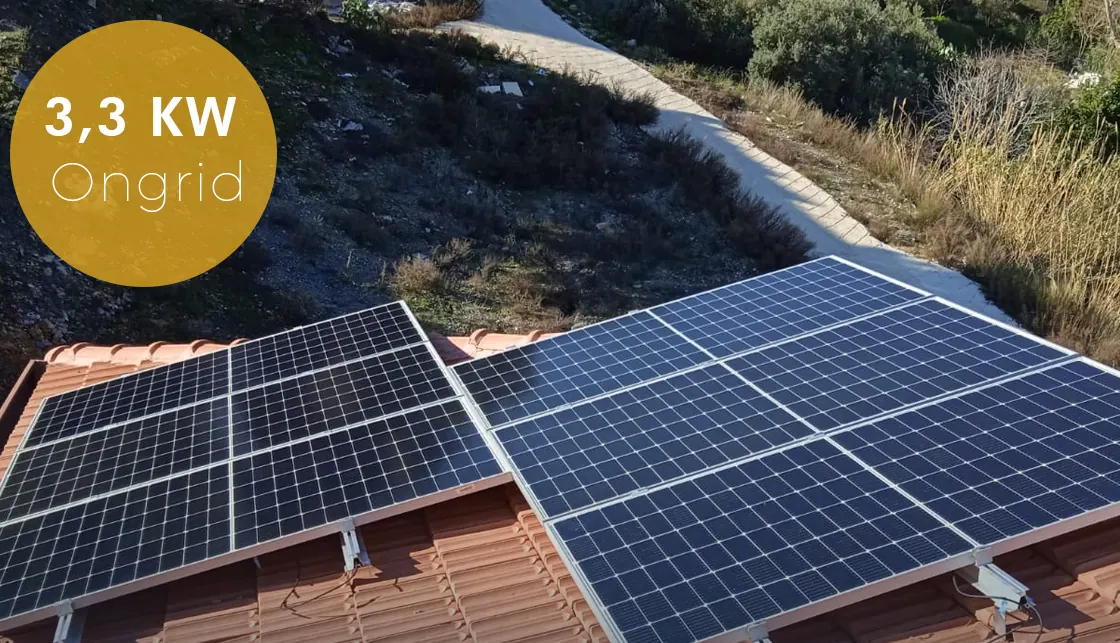
Our rooftop portfolio covers the whole range. A 3.3 kW on-grid system on a tiled roof shows how even a modest home array makes a visible difference to the electricity bill. On industrial buildings we have delivered on-grid rooftop plants of 450 kW, 860 kW, 970 kW, 1.3 MW and 4.5 MW, each designed around a structural assessment and the building's daytime load. For homes, see our residential solar page; for hotels and industry, our commercial solar page. If your roof is small or heavily shaded, ground-mount solar may be the better route.
Care, monitoring and carbon over the system's life
With no moving parts, rooftop solar needs little attention. In Antalya, dust, pollen and occasional Saharan dust settle on panels, so we usually recommend cleaning once or twice a year, more often near roads or construction sites. Remote monitoring shows production every day and flags drops in performance, so problems are found quickly. The same app shows the CO₂ your roof avoids, a figure that grows every sunny day and brings a carbon-neutral home or business visibly closer. Book a free rooftop survey to see how much Antalya solar energy your roof could harvest.