A home in Antalya enjoys some of the best sunshine in Europe, yet most households still buy every kilowatt-hour from the grid. Residential solar in Antalya changes that equation: your roof produces clean electricity during the day, your bills fall, and your home takes a real step towards carbon-neutral living, powered by Antalya solar energy.
We design systems for villas, apartments, townhouses and holiday homes from Kaş to Gazipaşa, for Turkish families and international owners alike. Every system is sized around how you actually live, from summer air conditioning and pool pumps to the electric car you may buy next year.
What solar energy in Antalya changes for your household
Household electricity use in Antalya follows the seasons. Consumption that stays modest from autumn to spring often doubles or triples between June and September, when air conditioners run for most of the day and pool filtration never stops. That is exactly when solar output peaks, so a well-sized home system covers a large share of the most expensive months directly.
Tariff structure matters too. Homes whose annual consumption exceeds the threshold set for the subsidised residential tariff move onto a higher, unsubsidised unit price. Large villas with pools and several air conditioners frequently cross that line, and for them every self-generated kilowatt-hour is worth noticeably more, which shortens the payback period considerably.
Sizing your home system step by step
- Collect twelve months of electricity bills to see your annual consumption and its seasonal pattern.
- Note when you use most energy: daytime cooling and pool pumps favour grid-tied systems, heavy evening use favours a battery.
- Divide the share of consumption you want to cover by Antalya's typical yield of about 1,500 to 1,600 kWh per kilowatt-peak.
- Check roof area and shading: each kilowatt-peak needs roughly five to six square metres of unshaded roof.
- Allow for future loads such as an electric car, heat pump or additional air conditioning.
| Home profile | Typical system | Indicative annual generation | Often paired with |
|---|---|---|---|
| City apartment or shared roof share | 2–4 kWp | 3,000–6,400 kWh | Grid-tied system |
| Family villa | 5–8 kWp | 7,500–12,800 kWh | Grid-tied, battery-ready inverter |
| Large villa with pool | 10–15 kWp | 15,000–24,000 kWh | Hybrid with LiFePO4 battery |
| Remote house without grid | Sized to load list | Designed for winter | Off-grid battery system |
Grid-tied, hybrid or off-grid: choosing for your home
Most homes start with a grid-tied system, which offers the lowest cost per kilowatt-hour and nets your surplus according to the current EPDK rules for your subscription. If you use most of your electricity in the evening, experience frequent outages or simply want more independence, a hybrid system with battery storage stores the midday sun for later. Properties without a practical grid connection, such as plateau houses and remote plots, are served by off-grid solar. We will model the options side by side so you can compare cost, savings and resilience.
Solar for international property owners
Many of our residential clients are foreign nationals who own villas and apartments in Antalya, Alanya, Kemer, Belek and Kaş. Owning property in Turkey gives you the same right to install solar as a Turkish citizen. In practice you need a Turkish tax number, which most buyers obtain during the purchase, and an electricity subscription in your own name. For apartments and gated complexes, the approval of the owners' association or management is usually required as well.
- The whole project is run in English, from the first video call to final handover.
- We prepare and follow the application to the regional distribution company (EDAŞ) on your behalf.
- Owners living abroad receive photo reports during installation.
- The monitoring app lets you follow production and savings from anywhere in the world.
Holiday homes and seasonal use
A holiday home used mainly in summer can still benefit from Antalya solar energy, because the occupied months are also the months of highest consumption and production. During empty months, a grid-tied system exports its output and the netting rules for your subscriber group determine how that energy is credited, which we explain before you invest. Some owners prefer a hybrid system so that security cameras, fridges and pool pumps keep running during outages while they are away, with alerts sent straight to their phones.
Rental properties benefit as well. Lower running costs make a villa more attractive to holiday guests and long-term tenants, and smart scheduling can run the pool pump and water heating on solar power while the house stands empty between bookings. We can also set up the monitoring so that a local property manager receives alerts alongside you.
A day of installation at your home
Most home systems are installed in one to three working days. The crew arrives with all materials, fixes the mounting rails to the roof structure, mounts the panels and runs the DC cabling. The inverter, protection devices and, where specified, the battery are installed in a shaded, ventilated location such as a utility room or garage. Before leaving, the team tests every string and tidies the site. Activation follows once the distribution company has completed acceptance and installed the bidirectional meter.
Design that respects your property
A premium home deserves a premium installation. We favour all-black panels where appearance matters, follow the lines of the roof, keep cable routes hidden wherever possible and avoid cluttering terraces. On tiled roofs, hooks sit beneath the tiles so the waterproofing remains intact. Flat roofs and terraces get low-profile frames that leave space for maintenance and, where wanted, for outdoor living. In complexes with architectural guidelines, we prepare drawings for the management before installation. A well-presented system adds to the appeal of a property, and the monitoring history gives future buyers verifiable proof of lower running costs.
Home references along the coast
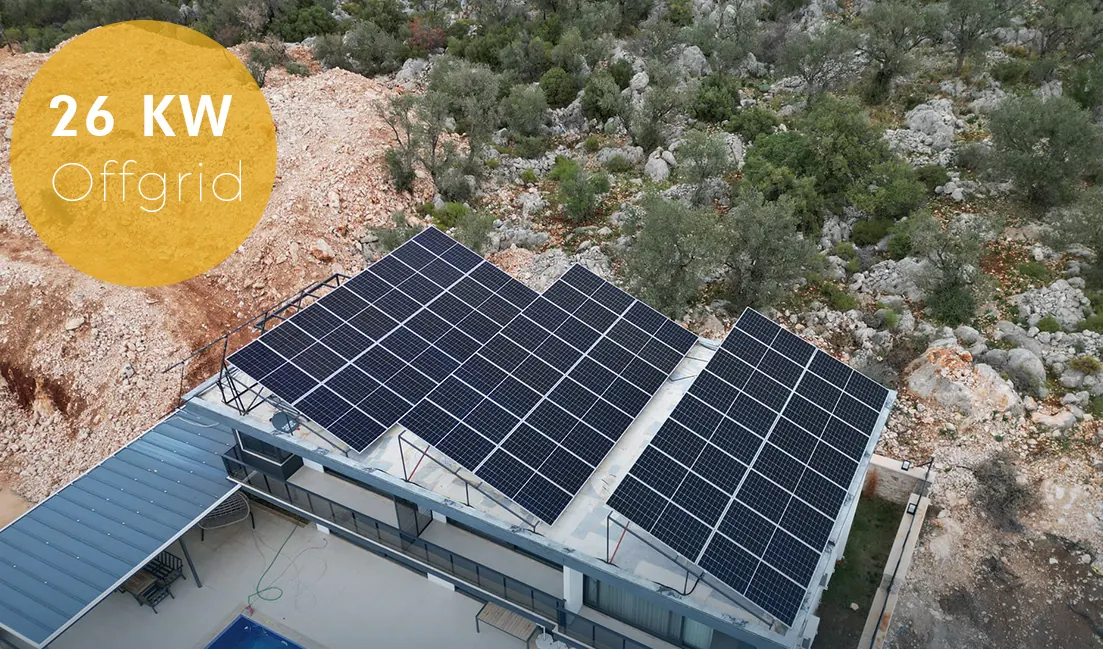
Our residential references range from a 3.3 kW on-grid system on a tiled roof to a 26 kW off-grid villa with a swimming pool and a 7.7 kW off-grid seaside villa in Kaş. Many homeowners choose storage: our hybrid projects include 15 kW systems in Konyaaltı, Kemer, Döşemealtı and Çakırlar and a 20 kW system in Kundu. Browse them on our projects page.
From a solar roof to a carbon-neutral home
For many households, solar energy in Antalya is the first step in a wider transformation. With panels on the roof, an electric car can run largely on sunshine, a heat pump can replace gas or oil for hot water and heating, and a battery can carry clean energy into the evening. A typical home system avoids several tonnes of CO₂ every year, and your monitoring app keeps count. Book a free home survey and we will show you how far your home can go.