Some of the most beautiful properties around Antalya sit beyond the reach of the grid: stone cottages on the plateaus above Kaş, garden houses among the vineyards of Döşemealtı, forest plots in the hills behind Kemer and orchard huts far from the nearest pole. Off-grid solar in Antalya turns these places into fully powered homes, with Antalya solar energy in place of a connection fee, a monthly bill or a line that may take years to arrive.
An off-grid system is also the purest form of sustainable living. Every light, fridge and fan runs on Antalya solar energy harvested on site, stored in batteries and used with care. We have designed and built off-grid systems from a 2.2 kW cabin to a 60 kW installation with its own battery room, and this page explains how we approach them.
When off-grid solar is the right choice
Off-grid makes most sense where a grid connection is impossible, unreliable or disproportionately expensive. Typical situations we see across the province include:
- Plateau houses and summer retreats in the Taurus foothills, used for part of the year and far from distribution lines.
- Coastal villas and plots near Kaş and Kalkan where extending the grid would mean long cable runs across rocky terrain.
- Garden houses, workshops and storage buildings on agricultural land that has no electricity subscription.
- Eco-lodges, glamping sites and retreats whose guests value a genuinely self-sufficient, low-carbon stay.
- Owners who simply want full energy autonomy and are ready to plan their consumption around it.
How an off-grid system works, component by component
Unlike a grid-tied system, an off-grid installation must produce, store and deliver every unit of energy itself. Each component therefore carries more responsibility:
- Solar array: Tier-1 monocrystalline panels, sized for the darkest design month rather than the sunniest.
- Charge control: MPPT controllers, often integrated in the inverter, that extract maximum power and charge batteries safely.
- Battery bank: LiFePO4 modules with an integrated battery management system that protects every cell.
- Inverter-charger: converts stored DC into stable 230 V AC and can accept a generator as a backup source.
- Protection and distribution: DC and AC breakers, surge protection, earthing and a clearly labelled consumer unit.
- Monitoring: an app showing production, battery state and consumption, which is invaluable for remote owners.
Sizing for Mediterranean life: the load list comes first
Good off-grid design starts with a detailed list of what you want to run and when. Antalya's climate creates a particular pattern: generous production for most of the year, shorter days in December and January, and high summer demand when air conditioning, pool pumps and water pressure pumps all work together. We size the array for winter and the battery for the evening and night, then check that hot summer evenings are covered too.
| Property profile | Typical daily use | Typical array | Typical battery |
|---|---|---|---|
| Weekend cabin: lights, fridge, router | 3–6 kWh | 2–3 kWp | 5–10 kWh |
| Garden house with tools or a small pump | 8–14 kWh | 4–5 kWp | 10–15 kWh |
| Seaside villa with efficient air conditioning | 18–30 kWh | 7–9 kWp | 20–30 kWh |
| Large villa with pool and several AC units | 60–100 kWh | 20–30 kWp | 60–100 kWh |
| Estate, farm or multi-building site | 150 kWh and above | 50 kWp and above | Dedicated battery room |
These ranges are indicative only. Your final design is calculated from your own load list, the orientation of your roof or ground area and the level of autonomy you want.
Battery storage: the heart of an off-grid home
In an off-grid system the battery is the most important investment, and the wrong choice is expensive to correct. We use LiFePO4 (lithium iron phosphate) chemistry because it tolerates deep daily cycling, offers thousands of cycles and remains thermally stable, which matters in a region where summer temperatures regularly pass 40°C. Batteries are installed indoors or in a shaded, ventilated enclosure, never in direct sun or an unventilated attic.
On larger sites we design a dedicated battery room with ventilation, fire-safe separation and clear access for service, as we did on our 60 kW off-grid project. For smaller homes, wall-mounted modules can be expanded later if your needs grow.
Winter, cloudy days and the art of autonomy
Antalya's winters are mild, but a run of grey days does happen. We plan a defined number of days of autonomy for essential loads and, where the property is used year-round, recommend a generator with automatic start as a safety net. In practice a well-designed system rarely needs it. A few habits also make off-grid living effortless:
- Run pool pumps, washing machines and dishwashers around midday, when the sun does the work.
- Choose inverter air conditioners and A-class appliances; efficiency is cheaper than extra batteries.
- Use solar thermal collectors or gas for water heating and cooking to keep electrical loads modest.
- Check the monitoring app before heavy evening use on a cloudy day.
Off-grid solar energy in Antalya: our references
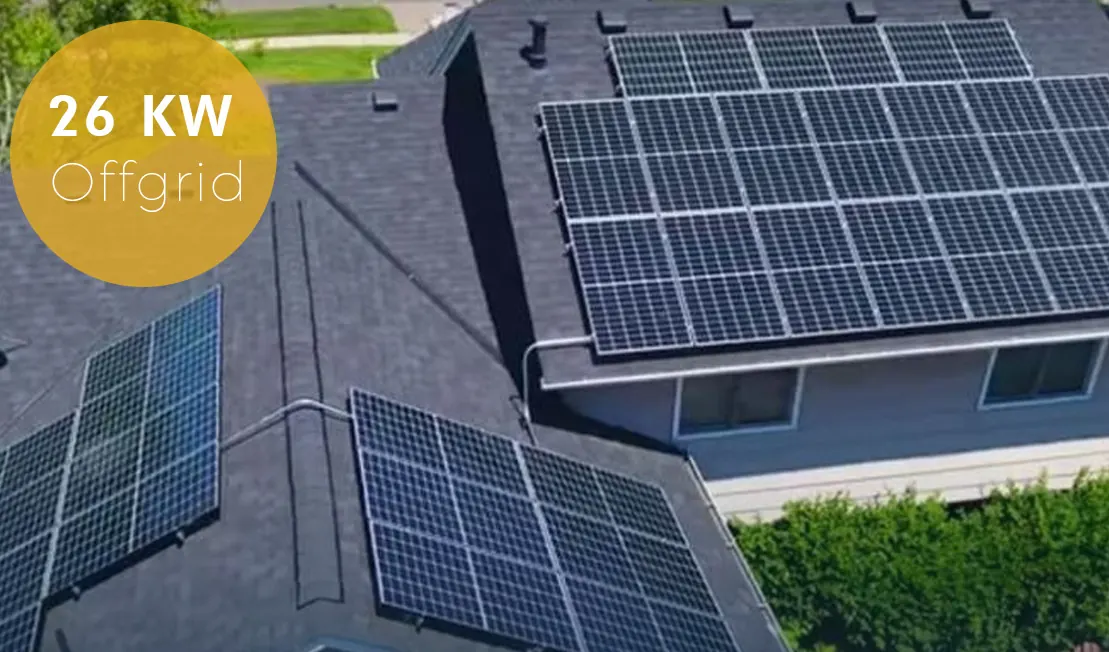
Our off-grid portfolio shows how flexible the technology is. On the coast we delivered a 7.7 kW off-grid seaside villa in Kaş, where a grid connection was not a practical option. Inland we built two 26 kW systems, one for a detached family house and one for a villa with a swimming pool, both designed to run comfortably through the summer cooling season. At the smaller end, a 4.4 kW system powers a garden house and a compact 2.2 kW installation keeps a cabin supplied with light, refrigeration and connectivity. Our largest stand-alone project is a 60 kW off-grid system with a dedicated battery room. You can also watch our Döşemealtı 8.2 kW off-grid installation in the project videos.
Permits, safety and long-term care
Because an off-grid system is not connected to the distribution network, no grid application or connection agreement is needed. That does not mean rules disappear: electrical installations must still be safe, properly earthed and protected against lightning and surges, and the property itself must comply with zoning rules. We review these points during the survey and document the installation for you.
After commissioning, remote monitoring lets us spot issues early, from a dirty array to a battery that is regularly cycling too deeply. We recommend a yearly inspection and panel cleaning, especially on dusty rural sites.
Planning your off-grid project with us
- Send us your location, photos of the site and a list of appliances you plan to use.
- We visit, assess sun exposure, mounting options and the best place for batteries.
- You receive a design with several autonomy scenarios and a transparent price.
- Our crew installs, commissions and trains you on the system and monitoring app.
- We stay available for maintenance, expansion and, if a grid line ever arrives, conversion to grid-connected or hybrid operation.
Ready to live independently on solar energy in Antalya? Request a free off-grid survey and we will show you what your site can achieve.