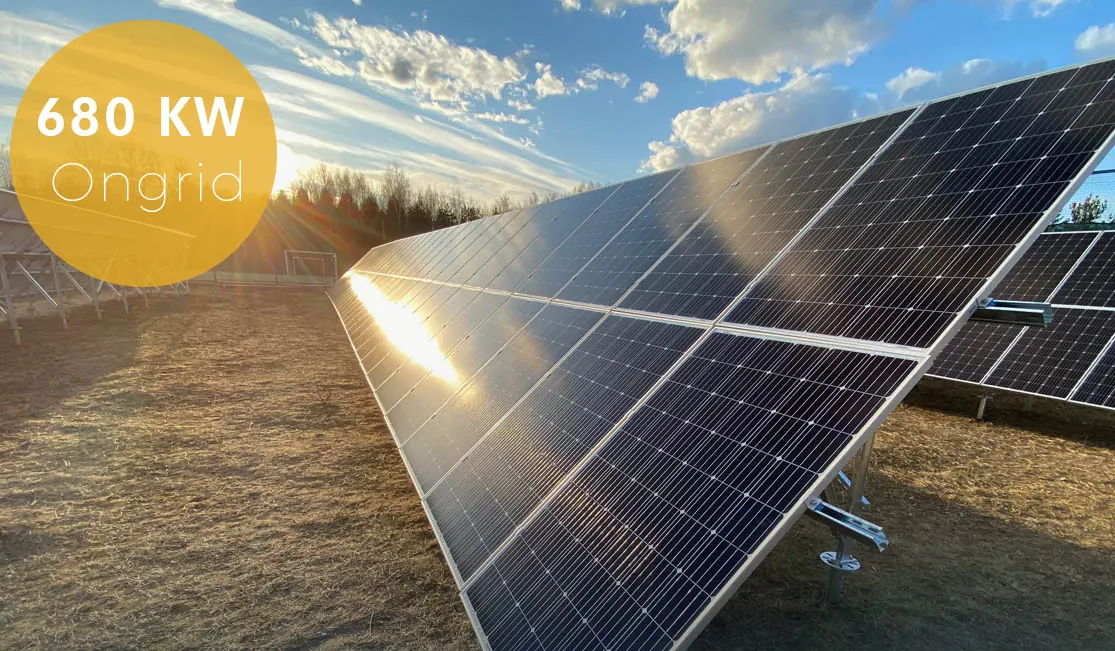
Where land is available, a ground-mounted array offers Antalya solar energy in its most efficient form: panels facing due south at the ideal angle, cooled by free-flowing air and reachable for cleaning without ladders or scaffolding. Ground-mount solar in Antalya ranges from a discreet array in a villa garden to multi-megawatt plants that supply industry and feed clean power into the grid.
We take ground-mount projects from the first look at a title deed through feasibility, permitting, construction and long-term operation. Our references include a 680 kW and a 2.4 MW on-grid ground plant, and the same engineering discipline goes into every smaller project.
When ground-mount beats a rooftop
Rooftop solar is usually the most economical choice when a good roof is available, because the structure already exists. Ground-mount becomes the better option in a number of common situations:
- The roof is too small, heavily shaded, poorly oriented or structurally unsuitable.
- You need more capacity than the roof can provide, for example for a factory, cold store or farm.
- You want the highest possible yield per kilowatt-peak through optimal tilt and spacing.
- Easy access for cleaning and maintenance matters, as on dusty agricultural sites.
- The property has unused land, a garden terrace or a field edge that can host the array.
Site selection: what makes a good plot for solar energy in Antalya
Before any design work we assess the land itself. The most important criteria are:
- Zoning and land class: productive agricultural land is protected, so the land-use status and title deed are checked first.
- Grid proximity and capacity: the distance to a suitable distribution line and the available capacity strongly influence cost and timeline.
- Topography: flat or gently south-facing slopes are ideal; steep or north-facing land increases cost and row spacing.
- Shading horizon: mountains, tree lines and buildings to the south reduce winter production.
- Soil and drainage: determine the foundation type and flood protection.
- Access: roads for delivery vehicles and later maintenance.
Permits and grid connection for land-based systems
Ground-mount projects involve two parallel tracks: land-use permission and grid connection. Systems linked to an existing consumption point, such as a factory, farm or home, can generally be developed under the Regulation on Unlicensed Electricity Generation, with the application made to the regional distribution company (EDAŞ). Stand-alone generation projects intended mainly to sell electricity follow different rules and may require licensing. Capacity limits, eligibility conditions and netting rules are set by EPDK and have been revised several times, so we confirm the current route for your project during feasibility rather than relying on fixed thresholds. Installation acceptance follows TEDAŞ procedures.
Timelines vary widely. A small system linked to a home or farm can move from application to activation within a few months, while larger plants depend on grid capacity, zoning procedures and the completeness of documentation. We prepare a realistic schedule during feasibility and keep you informed at every stage, so investment and construction can be planned with confidence.
Fixed-tilt structures or single-axis trackers?
Most ground-mount plants in the Antalya region use fixed-tilt structures: galvanised steel or aluminium frames set at an angle chosen for the best annual yield. They are robust, need almost no maintenance and cope well with coastal winds. Single-axis trackers, which follow the sun from east to west, can raise annual production noticeably, but they add moving parts, cost and upkeep. We model both options for larger sites and recommend trackers only where the extra yield clearly outweighs the extra investment over the plant's life.
Indicative land and yield figures
Land requirements depend on panel type, tilt, row spacing and terrain. The figures below are rough planning values for fixed-tilt systems on reasonably flat land:
| System size | Approx. land area | Indicative annual generation | Typical use |
|---|---|---|---|
| 5–20 kWp | 50–250 m² | 7,500–32,000 kWh | Villa garden, irrigation pump |
| 100 kWp | Roughly 1,500–2,000 m² | About 155,000–165,000 kWh | Farm, workshop, small hotel |
| 1 MWp | Roughly 1.5–2 hectares | About 1.55–1.65 GWh | Industry, large consumers |
Generation figures assume a fixed, optimally tilted array with good row spacing. Your yield simulation accounts for the actual terrain, horizon shading, temperature losses and equipment, and it forms the basis of the financial model we present to you or your lender.
Land stewardship and biodiversity around the array
A solar plant can be a good neighbour to the landscape. We favour pile-driven or screw foundations that avoid large concrete footprints and can be removed at the end of the plant's life, leaving the land reusable. Between and beneath the rows, a managed cover of native grasses and wild flowers reduces dust and erosion, supports pollinators and keeps panels cleaner. On suitable sites, sheep grazing can replace mechanical mowing altogether. These choices cost little at the design stage and strengthen the sustainability case of the investment, which matters to lenders, buyers and ESG-focused investors.
Our ground-mount references: 680 kW and 2.4 MW
Our ground-mount portfolio includes a 680 kW on-grid plant and a 2.4 MW on-grid plant, both built on open land with row spacing optimised to limit inter-row shading in winter, when the sun is low. At the smallest scale, a 5.5 kW ground-mounted solar irrigation system powers a field pump without any grid connection. The same principles apply whether you irrigate one field or supply a factory; see our solar irrigation and agricultural solar pages for farm applications.
Operation and maintenance for decades of yield
A ground-mount plant is a 25-year asset, and its returns depend on how well it is looked after. Our operation and maintenance services include remote monitoring with automatic fault alerts, scheduled panel cleaning, vegetation management, periodic thermographic and electrical inspections, and checks of structures, fences and cabling. Regular reporting compares actual production with the original simulation so that any shortfall is investigated early rather than discovered at year end.
Local conditions shape the maintenance plan of every Antalya solar energy plant. Dry summers and agricultural surroundings mean dust builds up quickly, so cleaning intervals are set from monitoring data rather than a fixed calendar. Fast-growing vegetation in spring is cut back before it shades the lower panel rows, and fences, gates and cameras are checked to protect the plant against theft and damage.
Ground-mounted arrays for villas and estates
Ground-mount solar energy in Antalya is not only for investors. Many villas around Döşemealtı, Kemer and Kaş have gardens or terraces that offer better orientation than a complicated roof. A compact ground array can be placed out of sight, tilted perfectly and cleaned easily, then connected to the house as an on-grid, hybrid or off-grid system. Request a free land survey and we will check zoning, distances and cable routes for you.