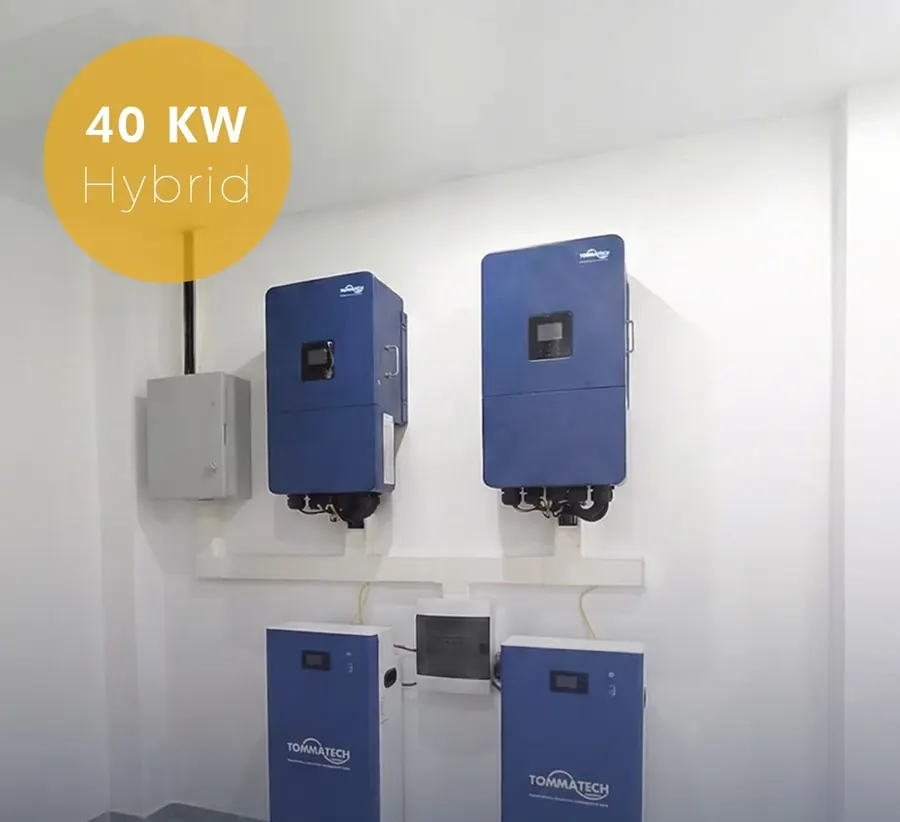
Solar panels produce most at midday, but many homes and businesses use most of their electricity after sunset. A hybrid solar and battery system in Antalya bridges that gap: it stores the surplus of the bright Mediterranean day in a LiFePO4 battery and releases it in the evening, at night or whenever the grid fails, so Antalya solar energy keeps working long after sunset.
Storage is the technology that turns solar from a bill-reduction tool into genuine energy independence. We have installed hybrid systems from Kemer to Manavgat, and this page explains how they work, how we size them and what they can and cannot do.
How a hybrid system works through the day
- Morning: panels start producing and supply the property's first loads directly.
- Midday: production exceeds demand; the surplus charges the battery before anything is exported.
- Afternoon: with the battery full, any further surplus is exported and netted under the rules for your subscription.
- Evening and night: the battery supplies the home or business, reducing grid imports when they would otherwise be highest.
- Power cut: the hybrid inverter isolates the property from the grid and keeps backed-up circuits running from the battery and panels.
Why storage matters more as netting rules evolve
Under monthly netting, surplus exported at noon could offset consumption later in the same month, so the grid acted almost like a free battery. Turkish rules have moved towards shorter settlement periods, including hourly netting for some subscriber groups, and exported surplus is often worth less than the retail price you pay. The shorter the netting period, the more valuable it becomes to use your own Antalya solar energy yourself, and a battery is the most direct way to do that. Because these rules continue to evolve, we confirm the current EPDK provisions for your connection before recommending a battery size.
LiFePO4: the battery chemistry we trust
Battery chemistry determines safety, lifespan and real-world cost. In Antalya's hot summers, thermal stability is especially important. The comparison below uses typical values; exact figures depend on manufacturer and model.
| Chemistry | Typical cycle life | Usable depth of discharge | Thermal stability |
|---|---|---|---|
| LiFePO4 (lithium iron phosphate) | Several thousand cycles | High, around 90% or more | Very good |
| NMC lithium-ion | Good, generally fewer than LiFePO4 | High | Lower; needs careful thermal management |
| Lead-acid | Limited | Around 50% for good lifespan | Stable, but sensitive to heat and deep cycling |
We therefore recommend LiFePO4 batteries with an integrated battery management system for homes, hotels and businesses, installed in shaded, ventilated spaces away from direct sun.
AC-coupled or DC-coupled?
There are two main ways to connect a battery. In a DC-coupled system, a hybrid inverter manages both panels and battery, and solar energy charges the battery with minimal conversion losses; it is our usual choice for new installations. In an AC-coupled system, a separate battery inverter is added alongside an existing grid-tied inverter. It suits retrofits, because the original equipment stays in place, at the cost of slightly higher conversion losses. If you already own an on-grid system, we will assess which route is more efficient for you.
Is a hybrid system right for you?
A battery is not the right answer for every property, and we will tell you honestly when a grid-tied system is the better investment. Storage tends to make the strongest case in these situations:
- Most of your consumption falls in the evening or at night, as in many family homes and restaurants.
- Power cuts are frequent or costly, for example in rural areas, on farms or in businesses with sensitive equipment.
- Your netting arrangement settles over short periods, so exported surplus is worth less than self-consumed energy.
- You want to charge an electric car on solar energy after work.
- You value independence and resilience as much as the payback figure.
If your property is empty during the day only occasionally and the grid is reliable, a grid-tied system with a battery-ready inverter may be the smarter first step, with storage added later as prices fall and needs change.
Sizing the battery and inverter
Good battery sizing starts with your load profile, ideally from smart-meter data or a few weeks of monitoring. We look at five parameters:
- Energy (kWh): how much you use between sunset and the next morning determines battery capacity.
- Power (kW): the largest loads that must run together, such as air conditioners or pumps, determine inverter size.
- Backup scope: whole-property backup needs more capacity than essential circuits only.
- Autonomy: sites with frequent or long outages need extra reserve.
- Expansion: modular batteries let you start smaller and add capacity later.
Backup circuits: deciding what stays on during an outage
Powering an entire villa, including several air conditioners and a pool pump, through an outage needs a large inverter and battery. Most owners instead choose an essential-loads circuit covering lighting, refrigeration, internet, security systems, water pumps and perhaps one air conditioner. We map your circuits during the survey, agree which ones belong on backup and wire a separate distribution board, so the switchover is automatic and you know exactly what keeps running when the grid goes down.
During a long outage the panels keep recharging the battery by day, so a well-sized system can ride through extended interruptions on backed-up circuits. The monitoring app shows battery level and consumption in real time, which helps you decide whether to run a heavier appliance or save capacity for the night.
Hybrid solar energy in Antalya: systems we have installed
Our hybrid references include 15 kW systems in Döşemealtı, Kemer and Çakırlar, two separate 15 kW systems in Konyaaltı, a 20 kW system in Kundu and a 40 kW system in Manavgat. Our project videos also show hybrid installations in Belek, Feslikan and Geyikbayırı (15 kW each) and in Döşemealtı at 12 kW and 40 kW. They range from family villas seeking evening independence to businesses protecting critical loads, and each was sized from the owner's real consumption profile. See them on our projects page.
Storage, electric cars and carbon-neutral living
Without storage, a typical home exports much of its midday solar power and buys grid electricity again after sunset. A battery closes that gap, pushing self-consumption far higher and letting you run your evenings on your own clean energy. Add an electric car and the benefits multiply: the charger can be set to use surplus solar during the day, or stored energy in the evening, so your daily driving runs largely on sunshine. For households aiming at a carbon-neutral home, a hybrid system is often the decisive step that makes solar energy in Antalya available day and night. Book a free survey and we will model the right battery for your home or business.